SEC Opens Onchain Stock Trading After CLARITY Act Fails
SEC Opens Onchain Stock Trading After CLARITY Act Fails
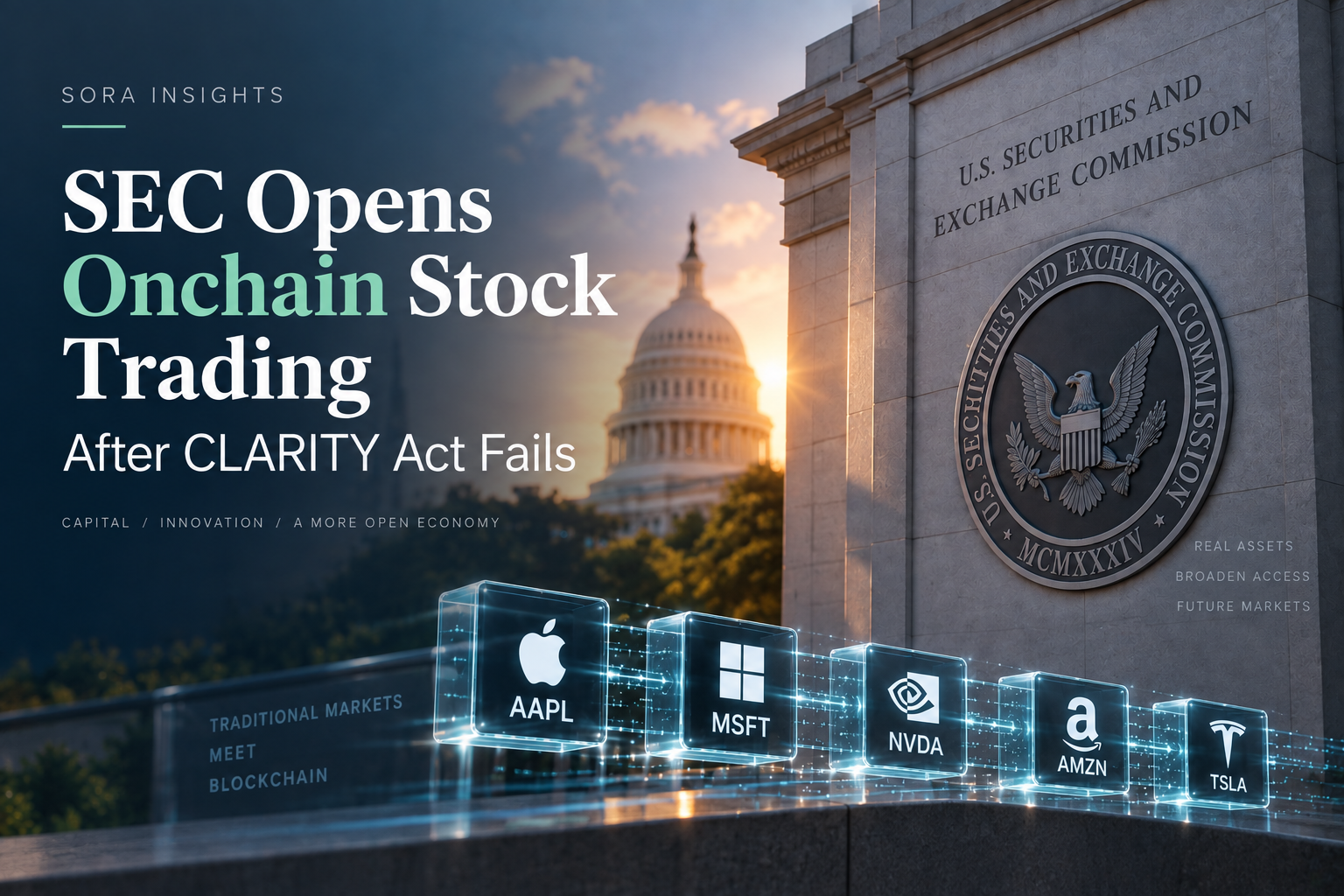
Two days after the Senate declined to advance the CLARITY Act, the U.S. Securities and Exchange Commission acted on its own authority. The relief is narrow, conditional, and set to expire in five years.
In a September 17 press release, the SEC has given listed companies a veto over onchain trading of their own shares. Consent is the default.
Under the order, a firm with no relationship to an issuer can tokenize that issuer’s U.S.-listed stock and list it on an onchain venue. Written notice goes to the issuer’s principal executive offices. Trading begins 30 calendar days later unless the issuer objects in writing. An objection blocks the listing. Silence permits it.
Directors of any company with a U.S. listing should know where that letter would arrive and who is authorized to answer it. The order draws no distinction by issuer domicile, so a Taipei, Seoul, or Hong Kong headquarters changes nothing about the obligation to respond inside the window. This is a governance decision, not a technology decision.
Why the Commission moved now
Cloture on the motion to proceed to H.R. 3633, the CLARITY Act, failed in the U.S. Senate on September 15, 2026 by 49 votes to 50, against a 60-vote threshold. Forty-eight hours later the U.S. Securities and Exchange Commission (SEC) issued the Innovation Exemption.
SEC Chairman Paul S. Atkins made the link explicit, writing that Congress “was unsuccessful in advancing the CLARITY Act despite the tireless efforts of many,” then framing the order as a step within the agency’s own statutory authority. Market structure stalled in the legislature, so the Commission reached for Section 36(a)(1) of the Securities Exchange Act of 1934 instead.
What the exemption grants
Release 34-106402 creates two temporary exemptions. Tokenized Securities Venues, or TSVs, are exempt from the definition of “exchange.” Certain proprietary liquidity providers, called Covered Firms, are exempt from the definition of “dealer.” Both expire five years after publication.
A TSV runs permissioned automated market maker liquidity pools for tokenized NMS stock, meaning ordinary U.S.-listed equities, and sets the standards for who may trade there. The Commission names the appeal directly: investor self-custody, around-the-clock trading, fractional ownership, and near-instantaneous settlement.
Four conditions define the perimeter.
- Scale is capped. Tier 1 stock, the S&P 500 and Russell 1000 plus certain ETPs, is limited to 75 symbols and 0.25 percent of prior-month average daily volume. Everything outside that tier gets 250 symbols and 2.5 percent. Exceed a volume threshold twice and the venue pauses that symbol for three months.
- Tokens must be real equity. Holders receive the same dividends, votes, and residual claims on liquidation as conventional shareholders. Synthetic exposure and tokenized swaps fall outside the definition.
- Infrastructure is public. Smart contracts must be auditable, public, and deployed on a public, permissionless ledger. Trade data goes out free and machine-readable within ten minutes of execution.
- Operators are U.S. persons. The venue must be a U.S. person and comply with OFAC programs. No borrowing, no hypothecation, no extension of credit. Books stay in the United States, open to Commission examination.
Anti-fraud and anti-manipulation law applies in full. A venue may not claim to be registered or approved, and must state plainly that it is not.
The Asia read
That U.S. person condition is the clause to read twice. A TSV operator must be a U.S. citizen, permanent resident, or entity organized under U.S. law. The constraint binds the operating entity rather than ownership, so an Asia-headquartered group can reach the exemption through a U.S. subsidiary. Running the venue itself from Hong Kong, Taipei, Seoul, or Singapore is not on offer.
Trading is a separate question. The Commission declined to restrict participation. Retail investors, institutions, and broker-dealers all qualify, subject to a venue’s permissioning standards and to sanctions and AML screening.
Disclosure may matter more than either. Venues publish an operating notice 30 days before trading, covering pricing mechanics, custody and clearing arrangements, governance, who holds upgrade authority over the smart contracts, and known failure modes. Regulators across Asia-Pacific get a working record of how tokenized equities behave against their conventional counterparts without running the experiment at home. The Commission says this is the point: experience with the order will inform whatever comes next, including rulemaking.
Three things this is not
- Not a crypto trading framework. Non-security crypto assets enter only as pairing assets beside a tokenized stock, and the order’s own example is a payment stablecoin from a permitted issuer.
- Not a capital formation channel. Primary issuance and initial offerings are prohibited. Secondary trading only.
- Not a ruling on decentralized finance. Commissioner Hester Peirce wrote that the “order is not about decentralized finance.” The Commission also declined to presume that relying on either exemption makes a firm an exchange or a dealer.
The clock nobody is discussing
Relief expires five years after Federal Register publication, and the order has not appeared there yet. The five-year term has not started, and the comment deadline remains unset. Rulemaking is anticipated rather than promised, so anyone building a venue is building on relief with a stated end date and no guaranteed successor.
Incumbents are not waiting. On September 14, three days ahead of the order, Cboe filed parallel fee schedule amendments across its four U.S. equities exchanges redefining a “Trading Platform” to include “a similar order-matching execution venue or decentralized platform (including blockchain-based or tokenized environments).” Those filings took effect immediately.
What we are watching
- Operating notices. Whether any venue files one, and what its disclosures reveal about custody, settlement, and clearing.
- Issuer objections. Whether issuers exercise the right, and whether a pattern emerges in who does.
- Regulation Crypto Assets. Whether the August 18 proposal reaches a final rule, and how the two frameworks reconcile.
- Asian response. Whether comparable relief appears in regional markets, and on what terms.
Regulatory outcomes arrive unevenly, and this one arrived by exemption rather than by statute. What tends to matter over a full cycle is not which framework lands first, but which participants built the governance, disclosure, and operational discipline to survive whichever one does. Conditions attached to this order are a fair proxy for what regulators across several jurisdictions will eventually ask for.
Sora Ventures is a global digital asset investment firm that strategically invests in and consults with publicly traded companies, primarily across Asia, while investing globally in venture, media, and financial platforms. We integrate disciplined digital asset strategies into the core of these businesses, supporting their transformation into modern financial platforms within local regulatory frameworks.
Sources:
- SEC Press Release 2026-90, September 17, 2026. https://www.sec.gov/newsroom/press-releases/2026-90-sec-issues-innovation-exemption-facilitate-trading-tokenized-nms-stock-request-comment
- Order, Release 34-106402, File No. 4-927. https://www.sec.gov/files/rules/exorders/2026/34-106402.pdf
- Fact Sheet, Release 34-106402. https://www.sec.gov/files/34-106402-fact-sheet.pdf
- Chairman Paul S. Atkins, Statement on the Innovation Exemption. https://www.sec.gov/newsroom/speeches-statements/atkins-innovation-exemption-bridge-toward-durable-rulemaking-091726
- Commissioner Hester M. Peirce, Innovation Exemption Statement. https://www.sec.gov/newsroom/speeches-statements/peirce-slumber-number-innovation-exemption-statement-091726
- U.S. Senate Roll Call Vote 234, September 15, 2026. https://www.senate.gov/legislative/LIS/roll_call_votes/vote1192/vote_119_2_00234.htm
- Cboe BZX fee schedule amendment, Release 34-106303, SR-CboeBZX-2026-072. https://www.sec.gov/files/rules/sro/cboebzx/2026/34-106303.pdf
- SEC Press Release 2026-76, Regulation Crypto Assets, August 18, 2026. https://www.sec.gov/newsroom/press-releases/2026-76-sec-proposes-new-regulation-crypto-assets
This analysis is for informational purposes only and does not constitute investment, legal, or tax advice. Status of the order as described is current as of September 19, 2026.

Mitty Chang is Chief Growth Officer and Operating Partner at Sora Ventures. He leads marketing, web engineering, and corporate strategy for the firm's publicly traded portfolio companies across Asia. Previously, he served as Senior Director of Web and Digital at Strategy (NASDAQ: MSTR) and has held fractional CMO and CTO roles across enterprise software, fintech, and digital media.