What Circle’s cirBTC Tells Us About Where Bitcoin Infrastructure Is Heading
What Circle’s cirBTC Tells Us About Where Bitcoin Infrastructure Is Heading
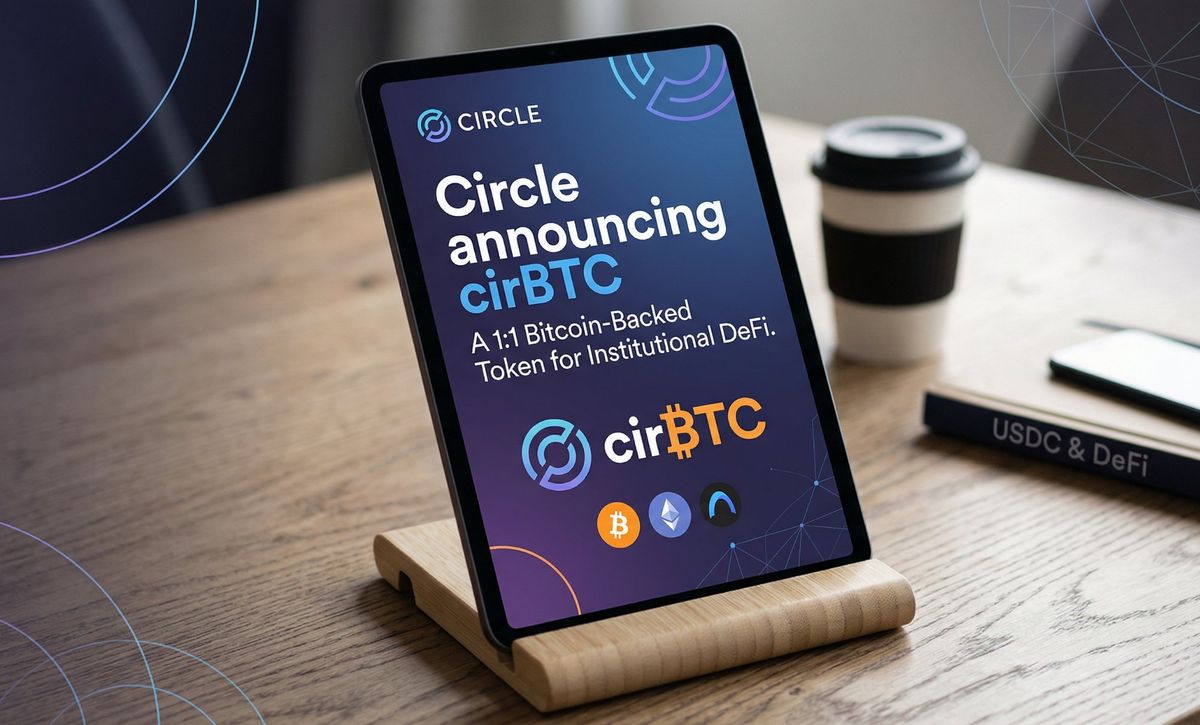
Circle built the institutional trust layer for stablecoins. Now it is applying the same playbook to Bitcoin.
On April 2, 2026, Circle announced cirBTC: a wrapped Bitcoin token backed 1:1 by native BTC, with reserves independently verifiable onchain in real time. It will launch on Ethereum and Circle’s own Layer 1 blockchain, Arc, before expanding to other chains. It is designed for OTC desks, market makers, lending protocols, and other institutional participants that require neutral, auditable, and liquid Bitcoin exposure across chains.
This is not a minor product announcement. It is a signal about the direction of institutional Bitcoin infrastructure.
What cirBTC Actually Is
A wrapped Bitcoin token is not a stablecoin. The distinction matters.
USDC is backed by US dollars, so its value stays at $1. cirBTC is backed 1:1 by real Bitcoin, which means its price moves with Bitcoin’s price. If Bitcoin falls 20%, cirBTC falls 20%. The “1:1 backing” is a guarantee of redeemability, not of price stability.
What cirBTC provides is utility: the ability to use Bitcoin across Ethereum’s DeFi ecosystem and Circle’s institutional settlement layer without moving native BTC out of custody. You deposit BTC, receive cirBTC, deploy it wherever Ethereum’s infrastructure allows, and redeem it for native BTC whenever needed.
Wrapped Bitcoin products have existed before. WBTC, the earliest major example, launched in 2019. The problem with WBTC was always trust: its reserves were managed by a small number of custodians whose governance raised questions from institutional participants who needed auditability at a higher standard. Circle is making an explicit claim that cirBTC solves this: no reliance on third-party attestations, no opaque custodians, and reserves verifiable onchain in real time by any counterparty.
The comparison to USDC is intentional. Circle is saying: we built the institutional trust layer that made dollar-backed stablecoins viable for serious financial participants. We are building the same layer for Bitcoin.
The Infrastructure Signal
The product itself is interesting. The signal behind it is more important.
Circle is one of the most credible infrastructure players in digital assets. It is a publicly listed company, subject to US regulatory scrutiny, and operating USDC at institutional scale. When Circle moves into a market, it is not speculating. It is identifying where institutional demand is headed and building the regulated infrastructure to meet it.
The decision to build cirBTC now reflects at least two things.
First, institutional demand for Bitcoin exposure across chains is real and growing. ETF flows have provided one entry point, but ETFs do not allow Bitcoin to function as collateral, as a settlement asset, or as a yield-generating instrument in DeFi protocols. cirBTC does. The institutions that have been accumulating Bitcoin through ETFs are the same institutions that will eventually want to deploy that Bitcoin productively. cirBTC is infrastructure for that next step.
Second, the trust problem with existing wrapped Bitcoin products is understood and unsolved in the market. Circle is entering precisely because WBTC’s governance concerns have not been resolved to institutional standards. By applying USDC’s reserve transparency model to Bitcoin, Circle is positioning cirBTC as the compliance-native alternative.
The Trade-Off Worth Acknowledging
Any discussion of cirBTC that ignores the counterparty risk question is incomplete.
With native Bitcoin, self-custody means no counterparty. Your keys, your Bitcoin. No one can freeze it, default on it, or fail to deliver it. cirBTC introduces Circle as a counterparty: you are trusting Circle to actually hold the backing BTC, maintain the peg, and not experience a custody failure.
For Bitcoin maximalists, this is an unacceptable trade. For institutional participants operating within compliance frameworks that require auditable counterparties, it may be precisely what they need.
Circle is betting that for the institutional market, trusted and auditable custody by a regulated entity is more valuable than self-custody risk. This is the same bet it made with USDC. The evidence so far suggests it was right.
What It Means for Asian Institutional Markets
For Asian institutional participants, cirBTC’s launch on Ethereum and Arc has a specific implication: Bitcoin exposure becomes available within the DeFi and settlement infrastructure that institutional operators in Hong Kong, Singapore, and Japan are increasingly building around.
Asian institutions that have been accumulating Bitcoin through exchange or custody channels will have a new option for deploying that exposure in structured products, lending facilities, and cross-border settlement. The cross-chain roadmap Circle has indicated means that Japanese, Korean, and Taiwanese market infrastructure could integrate cirBTC over time.
Custody risk remains the question to monitor. Whether Circle’s regulated custody model satisfies the requirements of institutional participants in HK, Singapore, and Japan will depend in part on local regulatory guidance on whether overseas custodians meet prudential standards. That guidance does not yet exist in most jurisdictions.
The Broader Pattern
cirBTC is one data point in a larger pattern. The institutional infrastructure layer for Bitcoin is being built systematically, by credible operators, with the same standards applied to traditional financial instruments.
Bitcoin ETFs established a regulated investment vehicle. The GENIUS Act framework is establishing regulated dollar-denominated settlement infrastructure. cirBTC is establishing regulated cross-chain Bitcoin utility. The Strategy (MSTR) playbook established corporate treasury adoption.
Each of these developments builds on the previous one. None of them is accidental. Taken together, they describe a market where Bitcoin is increasingly functioning as foundational balance sheet infrastructure, not a speculative instrument, and where the infrastructure required to use it that way is being built by the same institutions that built the infrastructure for every other asset class.
This is the trajectory Sora Ventures has invested toward. cirBTC is another confirmation that the trajectory is real.

Mitty Chang is Chief Growth Officer and Operating Partner at Sora Ventures. He leads marketing, web engineering, and corporate strategy for the firm's publicly traded portfolio companies across Asia. Previously, he served as Senior Director of Web and Digital at Strategy (NASDAQ: MSTR) and has held fractional CMO and CTO roles across enterprise software, fintech, and digital media.